
.png)

.jpg)


LEGAL INFO ABOUT THE OPAL MINING CLAIMS AND DEPOSITS IN VIRGIN VALLEY, NEVADA USA (Lode vs Placer):
- wentzellgems

- Apr 11, 2012
- 9 min read
Updated: Feb 8

UPDATED 2019. All content copyright by Christopher Wentzell. NO REPORODUCTION ALLOWED.
Virgin Valley lies in the northwestern corner of Nevada, southwest of Denio. Opals were first discovered here as float material, and claims were staked beginning in 1905. The original claims were for the surface float (alluvial) opal which had weathered out of the in-place deposits. Between 1918 to 1940, the surface float was exhausted, leaving only the in-place opal bearing deposits. The precious opal in Virgin Valley is found "in-place" (where it was originally formed and deposited) within a hard, defined and traceable sub-surface horizon or zone of bentonite. Under the United States Mining laws, a "Placer" mining claim is generally located for alluvial surface deposits containing valuable minerals, such as gold nuggets in a streambed or gravels, which are in a loose state, and are not "in-place," having eroded from the source (lode) deposit. A "Lode" mining claim, on the other hand, is located for valuable minerals occurring firmly embedded within any zone or deposit which is solid, in-situ, or "in-place." Further, a "Known Lode," is one that is known to have existed on a placer claim prior to the entry on the placer claim for locating a lode. Known lodes are open to location even after the placer claim has been perfected. The two types of deposits, lode and placer, are different, and mutually exclusive. (CASELAW CITE HERE). Therefore, a deposit is either lode, or placer, but cannot be both.
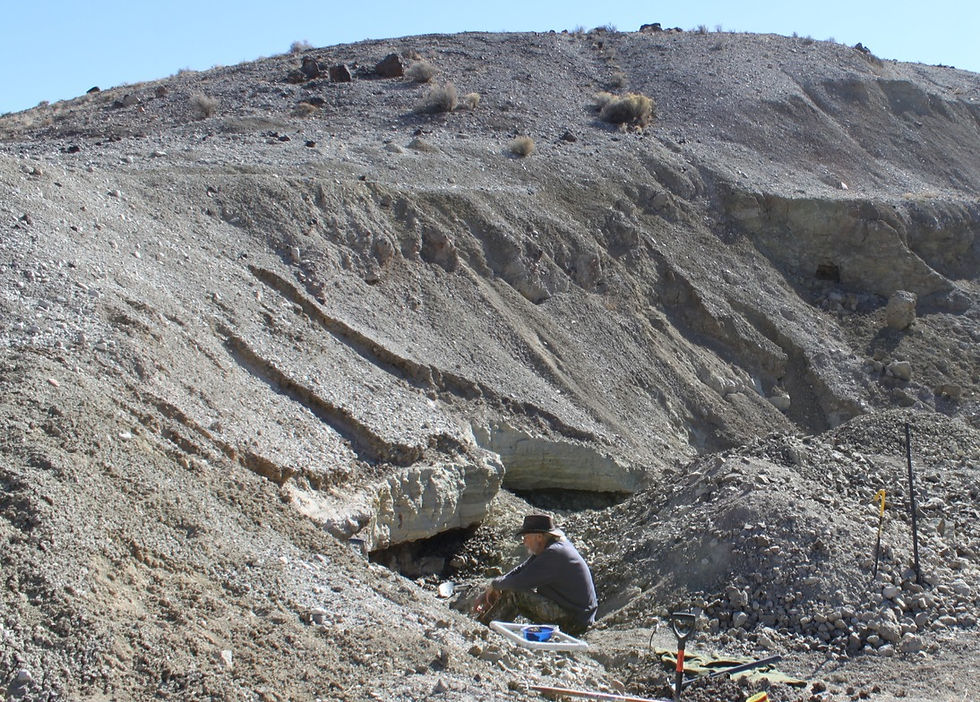
In the photo above, you can see the opal layer being dug below the bottom of the cream/white colored ash fall tuff and volcaniclastic layer. The host rock and opal-bearing zone is in-place, and well-defined; once found, this zone is followed as a "lead," the source word for LODE. This is basically the same for every in-place opal deposit and mine in Virgin Valley. Glen Hodson shows the same in-place formation and opal bearing zone at the Rainbow Ridge Mine in the video below:

The United States government mineral survey above shows that the opal-bearing deposits in Virgin Valley are found within a horizon or zone of bentonite. Bentonite has been defined as a mineral and consolidated clay rock derived from volcanic ash. Above and below the specific opal-producing zone, no commercially valuable deposit of opals are found to exist. The precious opals occur disseminated in-place throughout the opal bearing horizon or zone. This was readily apparent to all miners in Virgin Valley since the first discovery and mining of opals there. The above diagram is for the Royal Peacock Opal Mine, but all in-place opal deposits in the Valley have the same makeup of an opal producing horizon or zone, with unproductive material above and below.
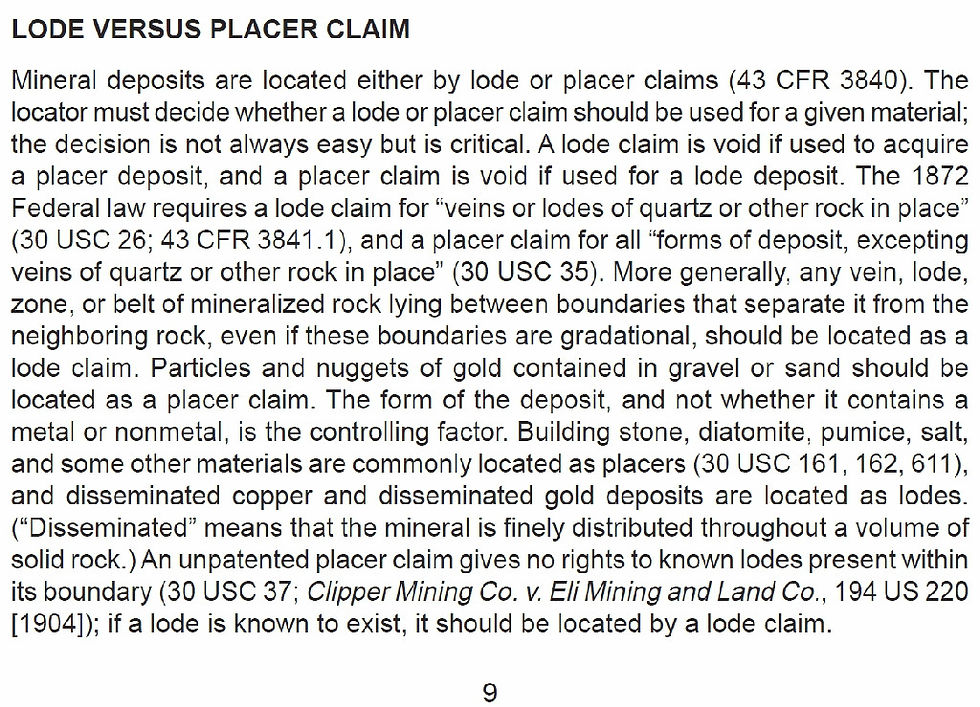
Here's the meat and potatoes of the whole thing. Any opals and mineral material found "in-place" (or, "in-situ") within the opal-bearing clay layers are part of the LODE deposit, which cannot be acquired by placer claims. A placer mining claim located for a lode deposit is void, under the U.S. Mining laws and decisions of the Nevada Supreme Court, 9th Circuit Federal Court of Appeals and other Federal Appeals Courts, and the United States Supreme Court, as well as the U.S. Department of the Interior, IBLA rulings. "A placer location is not a location of lodes or veins underneath the surface, but is simply a claim of a tract or parcel of ground for the sake of loose deposits of mineral upon or near the surface." CLIPPER MINING CO v. ELI MINING CO., 194 U.S. 220 at 228 (US Supreme Court 1904). Any vein, lode, zone or belt of mineralized rock lying between boundaries which separate it from the neighboring rock, even if the boundaries are gradational, must be located as a LODE claim under the State and Federal Mining laws and numerous Court decisions defining lode and placer deposits. (Papke and Davis, 2002, at page 9 of "MINING CLAIM PROCEDURES FOR NEVADA PROSPECTORS AND MINERS) . An unpatented placer claim gives NO RIGHTS to known lodes present within its boundary. Id. Further, a placer location will NOT sustain a lode discovery, nor will a lode discovery sustain a placer claim. COLE vs. RALPH, 252 U.S. 286, at 295-96 (U.S. Supreme Court, 1920); see also WEBB vs. LUJAN, 960 F.2d 89, at 90-91 footnote 1 (9th Circuit US Court of Appeals, 1992). Moreover, the location of any lode under the guise of a placer is a fraud and the claim would be void ab initio (or "from the beginning"). The same type of mineral deposit cannot be the basis for both a lode and a placer claim, SILBRICO vs. ORTIZ, 878 F.2d 333, at 336 (10th Circuit US Court of Appeals, 1989) at paragraphs 12-15. As held by the United States Supreme Court, "... no right arises from an invalid claim of any kind. All must conform to the law under which they are initiated; otherwise they work an unlawful private appropriation in derogation of the rights of the public." CAMERON vs. UNITED STATES, 252 U.S. 450, 460, 40 S.Ct. 410, 412 (1920). Moreover, invalid placer claims cannot be amended into, nor inure to, lode locations, IN RE PAUL VAILLANT, 90 I.B.L.A. 249, at 253 (U.S. Dept Interior, Board of Land Appeals, 1986)(a Virgin Valley opal claims case)>https://www.oha.doi.gov/IBLA/Ibladecisions/090IBLA/090IBLA249.pdf, cited in SILBRICO, Supra. Moreover, in a lode vs placer dispute, the issue is whether the discovery is proper as a lode or as a placer, not which claim was located first. A presumption giving priority of right against a subsequent locator does not attach to an invalid location in a lode vs placer dispute, as priority of time (which claim was located first) is not the issue, (GILMORE CITE HERE) . This is especially true where the placer claimants knew the form and character of the deposit, and themselves and/or their families located lode claims for the same type of deposit elsewhere in the Valley and over their own placer claims for the same type of deposit. Many claim owners in Virgin Valley, knowingly ignore, disregard and side-step these issues. When the placers were mined out and they started digging into the hill, and "in-place" deposit, a LODE mining claim was REQUIRED. Surface rights to the pre-existing placers only contain the right to any surface float and alluvial surface material existing on the date of placer location, not to any material removed, mined or tailings created from mining the in-place lode under the guise of a placer claim, as such would invalidate the placer claim ab initio for fraud. The placer claims did not gain priority over the known lode. Likewise, as shown below, Placer claims cannot be staked over existing valid lode claims, and any such claim is void ab initio both for trespass and due to the exclusive nature of the lode claim. Nevada law specifically recognizes lode claims located within pre-existing placers (add case cite here #1928PVH).
Generally speaking, bedded or layered deposits are normally staked as placers IF the valuable mineral itself is the sole bedded mineral (ie, building stone, calcium carbonate, etc). However, this does not apply when the valuable mineral occurs within and inside of the bedded deposit, then it is a lode, and the law is very clear and well-settled on this. This applies to Sedimentary rocks (CASELAW CITE HERE). If you have, or are buying, an opal mining claim in Nevada's Virgin Valley, and the opal is found in-place in the clay within a defined zone, MAKE SURE THAT YOU HAVE OR ARE BUYING A LODE CLAIM, because a placer claim has no rights to the lode deposit, and someone else can stake it. LET ME REPEAT THIS: anyone having unpatented placer mining claims in Virgin Valley for the in-place opal-bearing deposits, my sincere recommendation to you is, if someone hasn't already filed a lode claim for the opal deposit, you should file a lode claim now to obtain the rights to same before someone else does: If you are digging opals out of the in-place clay deposits in Virgin Valley, it is a LODE. Any lode claim staked over a prior improper placer claim will have seniority, priority and exclusive title and rights to the in-place opal bearing deposit and all Known Lodes. It's the law, and the law is the law for a reason. Anyone who tells you different in Virgin Valley, including John Church of Swordfish Mining Opal, is blowing smoke in your face to push his/their own personal agenda. PERIOD. THE LAW IS THE LAW.



Oh, and by the way, John Church KNOWS all of this, but will lie and manipulate to get his way. He KNOWS the different rights and basics between lode and placer, and he cannot argue otherwise in a court of law, as according to HIS OWN STATEMENT:
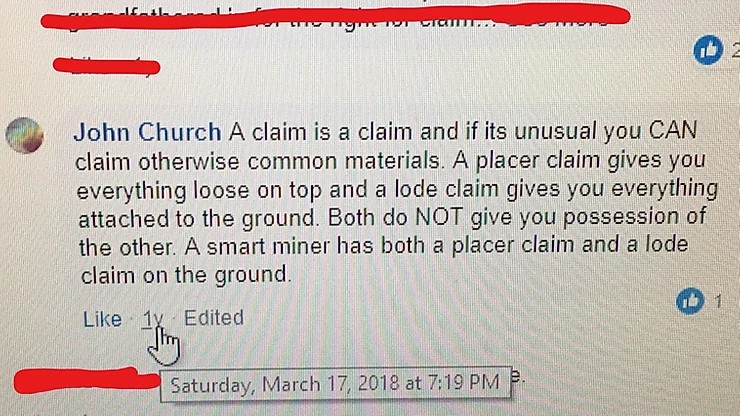

John Church's (and I presume other people associated with him) last argument trying to wiggle around the above is that both lode and placer claims have been patented in Virgin Valley for the same deposit, so he makes the false assumption that you can stake either type of claim with validity. SUCH IS NOT THE LAW. There are 5 patented mines in Virgin Valley (1 patented as placer, the others all as lodes):
1. RAINBOW RIDGE, 1929 & 1930 (placer)(Patent EXCLUDED KNOWN LODES)(See, next photo below);
2. ROYAL PEACOCK, 1980 (LODE);
3. BONANZA (LODE)(previously HODSONS placers that were overstaked by HODSON himself with Lodes;
4. REEDS (LODE) (1980)
5. BIRDLEBOUGHS (LODE)(1992)(previously placers that were overstaked by LODES).

The land department (predecessor to BLM) regularly made mistakes in issuing patents for the same type of deposit in the early days as both lode and placer claims; this normally happened because there were no adverse suits. If a lode was known, it did not need to adverse. BY LAW A KNOWN LODE IS EXCLUDED from a placer patent and does not pass thereby. Despite these facts, it does not excuse compliance with the law then nor at the present time. This is not legal to base the argument that "either type of claim will work for the same type of deposit because patents have been given to both in the past", as the LAW dictates what type of claim is required (IN PLACE is LODE; anything not in place is placer; not to mention that known lodes are excluded from placer patents by statute). Mining District custom cannot form a basis to stake either type of claim for the deposit when such custom is contrary to the Statutes and caselaw. Such custom is void and no reliance can be given on past practice for violation of the statute as in-place deposits must be staked as lodes. Placer patents do NOT convey lodes known to exist on the date of the placer patent application, and they remain open to location. The statute is plain and clear, and known to everyone who is involved with mining. All Virgin Valley opal miners realized this in the late 1970s after an article discussing this appeared in a national magazine. Hodson himself overstaked his own Virgin Opal placer as the Bonanza Opal Lodes and patented them as lodes. All of the Virgin Valley miners who went to patent in the 70's-90's changed to LODES. Hodson also staked the Rincon Belle Extension LODE as an extension of the KNOWN LODES in the Rainbow Ridge placers in the 1990s. I did not make this up, it has been going on in Virgin Valley since the first claims were put in and Lockheed made the wrong choice of relocating as placers (they were cheaper to patent) and everyone followed suite without checking THE LAWS. Not to mention that economic opal placer deposits DO NOT EXIST (except for one deposit in Brazil) because opals are too fragile to survive mechanical movement. Thus, there is only one outcome:
1. In-place opal-bearing deposits are LODES, and not subject to placer location. If staked, located or patented as placers, they can be claimed by lodes, as the lodes were known and excluded therefrom.
There is no way around it.
But, in the event that John or anyone else wants to argue otherwise, it doesn't alter the above conclusions but would open another can of worms in the valley that I will be happy to exploit.......
EDIT: LAST UPDATE DECEMBER 24, 2019
Comments